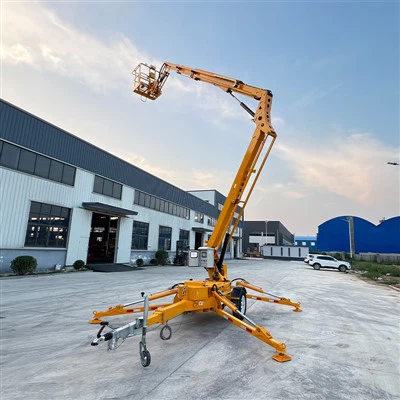
Measuring the performance of an order picker is crucial for businesses that rely on efficient order fulfillment processes. As an order picker supplier, we understand the importance of evaluating the performance of these machines to ensure optimal productivity and cost - effectiveness. In this blog, we will explore various methods and key performance indicators (KPIs) to measure the performance of an order picker.
1. Throughput
One of the most fundamental ways to measure the performance of an order picker is by evaluating its throughput. Throughput refers to the number of orders or items that can be picked within a specific time frame. This metric is essential as it directly relates to the overall efficiency of the order - picking operation.
To calculate throughput, you can use the following formula:
[Throughput=\frac{Number\ of\ items\ picked}{Time\ taken}]
For example, if an order picker picks 150 items in a 4 - hour shift, the throughput would be (\frac{150}{4}=37.5) items per hour. Higher throughput indicates that the order picker is more efficient in handling orders.
However, it's important to note that throughput can be influenced by several factors, such as the layout of the warehouse, the complexity of the orders, and the training of the operator. For instance, a well - organized warehouse with clear aisles and proper storage systems can significantly improve throughput.
2. Accuracy
Order accuracy is another critical performance indicator. Inaccurate order picking can lead to customer dissatisfaction, returns, and additional costs for the business. To measure order accuracy, you can use the following formula:
[Order\ Accuracy=\frac{Number\ of\ accurate\ orders}{Total\ number\ of\ orders}\times100%]
For example, if an order picker processes 200 orders and 190 of them are accurate, the order accuracy rate is (\frac{190}{200}\times100% = 95%). A high - accuracy rate is desirable, and businesses should aim for an accuracy rate of at least 98%.
To improve order accuracy, proper training of operators is essential. Additionally, using barcode scanners and other technology can help reduce errors. Our Self - propelled Order Picker is equipped with advanced scanning technology that can enhance order accuracy.
3. Uptime
Uptime refers to the amount of time an order picker is operational and available for use. Downtime, on the other hand, is the time when the order picker is not working due to maintenance, breakdowns, or other issues. A high uptime percentage is crucial for maintaining a smooth order - picking operation.
To calculate uptime, you can use the following formula:
[Uptime=\frac{Total\ operational\ time}{Total\ available\ time}\times100%]
For example, if an order picker is available for 8 hours a day and is operational for 7 hours, the uptime is (\frac{7}{8}\times100% = 87.5%). To improve uptime, regular maintenance and servicing of the order picker are necessary. Our company provides comprehensive maintenance services for our Semi Electric Order Picker to ensure high uptime.
4. Energy Efficiency
In today's environmentally conscious world, energy efficiency is an important performance metric for order pickers. Energy - efficient order pickers can help reduce operational costs and minimize the environmental impact.
To measure energy efficiency, you can calculate the energy consumption per unit of work. For example, you can measure the amount of electricity consumed by the order picker to pick a certain number of items. A more energy - efficient order picker will consume less energy to perform the same amount of work.
Our order pickers are designed with energy - saving features, such as regenerative braking systems and efficient electric motors. These features not only reduce energy consumption but also extend the battery life of the order picker.
5. Operator Productivity
The productivity of the operator using the order picker is also an important aspect of performance measurement. An efficient operator can significantly improve the overall performance of the order - picking process.
To measure operator productivity, you can consider factors such as the number of orders picked per hour, the time taken to complete a task, and the accuracy of the orders picked. Training programs can be implemented to improve operator skills and productivity.
6. Cost - effectiveness
Cost - effectiveness is a key consideration when evaluating the performance of an order picker. This includes not only the initial purchase cost but also the operating costs, such as maintenance, energy consumption, and labor costs.
To calculate the cost - effectiveness, you can use the following formula:
[Cost - effectiveness=\frac{Total\ benefits}{Total\ costs}]
Total benefits can include factors such as increased throughput, improved order accuracy, and reduced downtime. Total costs include the purchase price, maintenance costs, energy costs, and labor costs.
7. Ergonomics
Ergonomics plays a vital role in the performance of an order picker. A well - designed order picker that takes into account the comfort and safety of the operator can improve productivity and reduce the risk of injuries.
To measure the ergonomic performance of an order picker, you can consider factors such as the operator's reach, visibility, and the ease of use of controls. Our order pickers are designed with ergonomic features, such as adjustable seats, easy - to - reach controls, and good visibility, to ensure operator comfort and safety.
Conclusion
Measuring the performance of an order picker is a multi - faceted process that involves evaluating various key performance indicators. By focusing on throughput, accuracy, uptime, energy efficiency, operator productivity, cost - effectiveness, and ergonomics, businesses can ensure that their order - picking operations are running smoothly and efficiently.


As an order picker supplier, we are committed to providing high - quality order pickers that meet the performance requirements of our customers. If you are interested in learning more about our order pickers or would like to discuss your specific needs, we encourage you to contact us for a procurement negotiation. We look forward to working with you to optimize your order - picking processes.
References
- Smith, J. (2020). Warehouse Operations Management. Publisher Name.
- Brown, A. (2019). Order Picking Strategies and Technologies. Journal of Logistics and Supply Chain Management.