


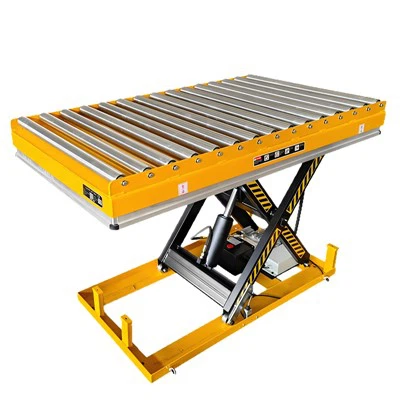
Stationary Lift Tables


Increasing the lifting speed of a stationary scissor lift requires coordinated optimization of the hydraulic system, mechanical structure, and power configuration. Since these platforms typically employ hydraulic drives and scissor mechanisms, the lifting speed is primarily influenced by hydraulic flow rate, cylinder size, load, and mechanical geometry.
The following is a structured technical analysis of existing methods.
1. Increasing Hydraulic Flow Rate (Main Method)
Use a hydraulic pump with a larger flow rate.
Because the lifting speed of a stationary scissor lift is directly proportional to the pump flow rate:
Therefore, the following methods can be used:
Replace with a gear pump with a larger displacement.
Increase the motor speed (within safe limits).
Use a multi-pump configuration. When changing the pump flow rate, the following should be noted:
Motor power must match the increased flow rate requirement.
System pressure must be maintained within the design rating range.
Oil temperature rise must be controlled.
If the motor is the limiting factor, upgrade to a higher-power motor.
2. Reducing the Effective Cylinder Area
Because speed = flow rate ÷ piston area:
Therefore, with a constant flow rate, using a smaller diameter hydraulic cylinder or replacing a large diameter hydraulic cylinder with two smaller diameter cylinders can increase the lifting speed of a stationary scissor lift. However, this also brings another problem. A smaller cylinder diameter reduces the lifting force of the fixed scissor lift, and the pressure also increases, requiring the replacement of hydraulic hoses with those having a higher pressure resistance.
3. Optimize Hydraulic Circuit Design
Besides flow rate and cylinder diameter, sometimes the design of flow valves and hydraulic hoses also affects the entire system. We can solve this problem by increasing the diameter of valves and pipes. Reducing the number of elbow joints, using shorter hose paths, replacing with high-quality connectors, and using clean hydraulic oil (reducing viscosity loss) can all reduce pressure loss. In addition, it is essential to ensure that there are no bends in the hydraulic lines.
4. Improve Scissor Mechanism Geometry
The lifting speed at the platform depends on:
Cylinder mounting position
Scissor arm length
Initial lifting angle
At a smaller angle, the scissor mechanism can amplify more vertical motion per unit cylinder stroke. Therefore, we can reposition the cylinder pivot point, optimize the arm length ratio, and reduce the number of scissor hydraulic cylinder layers to achieve a higher transmission ratio for the fixed scissor lift.
Hot Tags: stationary lift tables, China stationary lift tables manufacturers, suppliers, factory, mini scissor lift, 19 foot scissor lift, stationary lift table, stainless lift table, table with lift, scissor lift platform
You Might Also Like


Send Inquiry