


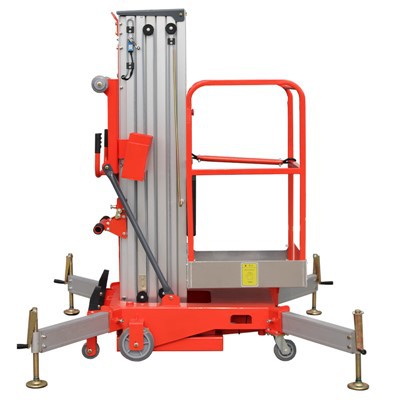
Aluminum Alloy Mast Lifting Platform With Support Legs

Aluminum Alloy Mast Lifting Platform With Support Legs suppliers

Aluminum Alloy Mast Lifting Platform With Support Legs factory

Aluminum Alloy Mast Lifting Platform With Support Legs best

Aluminum Alloy Mast Lifting Platform With Support Legs high quality

Aluminum Alloy Mast Lifting Platform With Support Legs price

Aluminum Alloy Mast Lifting Platform With Support Legs high quality
Aluminum Alloy Mast Lifting Platform With Support Legs


How to properly use a single mast aluminum lift?
The single mast aluminum alloy lift (referring to the manually pushed, electrically powered lifting type) is designed for indoor maintenance, installation, and inspection work at medium heights, typically with a lifting height of 4-10m. For higher lifting heights, a dual mast type lift or a 4-mast lift can be used, with a maximum lifting height of up to 16m. When using a single mast lift for high-altitude work, special attention should be paid to the condition of the equipment itself and the site conditions.
1) Safety inspection of the single mast lift platform before use (must be performed before each use)
Check the mast, welds, and fasteners for cracks or deformation.
Check the hydraulic lines/cylinders or winch steel cables for leaks, wear, or abnormal noise.
Test the lifting button, emergency stop button, and lowering valve.
Check the guardrails, toe boards, and limit switches.
Check the battery level or power cord condition.
2) Site preparation
When using the aluminum alloy lift, ensure that:
The ground slope does not exceed 1.5°;
The ground is firm and level;
Avoid slopes, soft ground, drainage ditches, or ground openings;
Check for beams, sprinklers, lights, and live wires overhead;
It is recommended for indoor use;
Avoid use in windy, rainy, or uneven outdoor conditions.
3) Positioning and stabilization
Move the lift to the working position and lower the platform completely.
Extend and lock the outriggers, adjusting their height to ensure they are fully secured to the ground.
Level the equipment using the adjustable outriggers; the bubble level should be centered.
Important: Never raise the platform unless all outriggers are extended and locked.
4) Entering the aluminum alloy lift platform
Use the designated lift platform entrance, close and lock the safety gate.
Ensure the load does not exceed the rated load (personnel + tools).
Wear a helmet, non-slip shoes, etc.
5) Lifting operation
Use the controls to raise the platform vertically – avoid sudden movements.
Do not tilt excessively or apply lateral loads.
Keep both feet on the platform at all times; keep your body within the guardrails.
Before working at height, always check the equipment's stability. 6) During high-altitude work:
Do not move: Do not move the lifting platform after it has been raised.
Do not climb: Do not stand on the guardrails, boxes, or ladders on the platform.
Tool management: Avoid dropping objects; use safety ropes for tools if necessary.
7) Lowering and shutdown:
Clear the area below the aluminum alloy lifting platform, then lower it smoothly.
After it has been fully lowered, retract the outriggers.
Turn off the power. If battery power is used, charge the battery for future use.
Post-use inspection: Record any problems encountered during use for maintenance purposes.
Hot Tags: aluminum alloy mast lifting platform with support legs, China aluminum alloy mast lifting platform with support legs manufacturers, suppliers, factory, mast lifts, Personal Mast Lift, Single Mast Man Lift, boom lift man lift, Vertical Mast Lift, Aluminum Single Man Lift
You Might Also Like


Send Inquiry